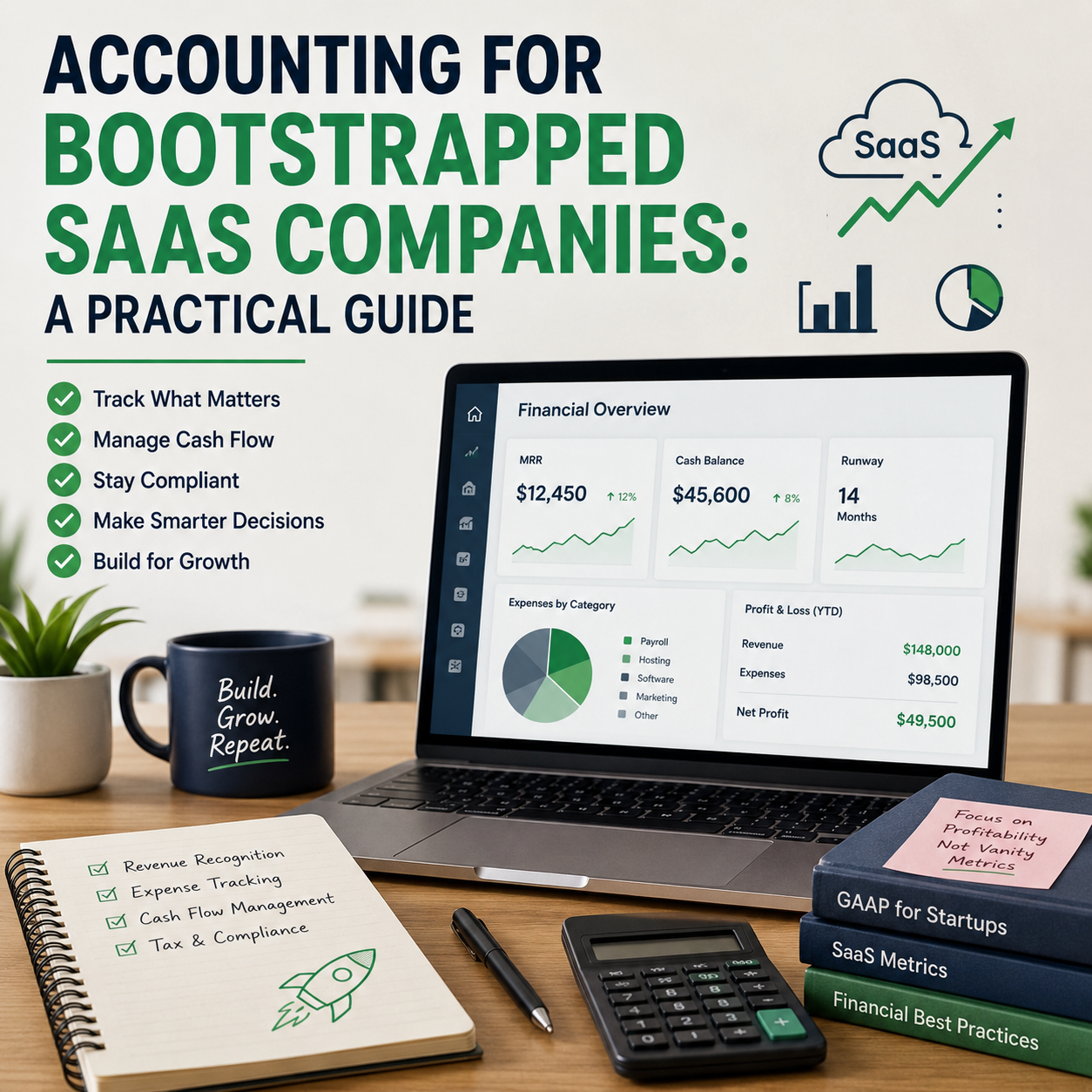

The narrative around SaaS accounting usually assumes you're chasing venture capital.
Investor-ready financials, clean books for due diligence, ASC 606 compliance for your Series A.
But what if you're not raising?
What if you're building something profitable, self-funded, and intentionally small?You still need great accounting. In some ways, you need it more — because you don't have an investor's finance team looking over your shoulder, and there's no safety net if the cash dries up.
Why Bootstrapped SaaS Founders Ignore Their Books (And Why That's a Mistake)Without investor pressure, financial discipline often gets deprioritized.
You're focused on product and customers — not month-end closes. Revenue hits your bank account and expenses go out; as long as the balance is positive, things feel fine.
The problem: you don't know your actual gross margin. You can't tell whether your pricing is covering your COGS. You have no idea which customers are profitable. And when a big opportunity comes — an enterprise deal, an acquisition inquiry, or a revenue-based financing offer — you're scrambling to clean up months or years of messy books.Stage 1: Pre-Revenue to $10K MRR — The FoundationsSet up a proper chart of accounts in QuickBooks Online or Xero from day one.
Separate business and personal finances completely — this is non-negotiable.Start with cash-basis accounting if necessary, but structure your books so switching to accrual is straightforward later.Track every expense in the right category: COGS (hosting, payments, customer success tools), S&M, R&D (your time if you're the sole developer), and G&A.Reconcile your bank account monthly.
This catches errors early and ensures your books reflect reality.Stage 2: $10K to $50K MRR — Getting SeriousAt this stage, your accounting needs to level up:Switch to accrual-basis accounting and implement proper revenue recognition for subscriptions.
Even if you never raise, accurate ARR and MRR figures help you make better pricing and growth decisions.Build a monthly P&L review habit. Know your gross margin, your biggest expense categories, and your net income trend.Separate your salary from owner distributions — pay yourself a market-rate salary as an expense, so your P&L reflects actual profitability.Consider hiring a part-time SaaS bookkeeper. At $10K+ MRR, the ROI is clear: better decisions, less time lost, lower tax burden.Stage 3: $50K+ MRR — Professional-Grade BooksAt this level, you're running a real business.
Your accounting should reflect that:Monthly closes within 15 days of month-end. No more catching up three months later.Full accrual accounting with proper deferred revenue tracking.Quarterly tax estimates and proactive R&D credit evaluation — bootstrapped companies often leave significant R&D credits on the table.KPI dashboard including MRR, churn, LTV:CAC, and gross margin — not just for investors, but for you.Year-end financial statements ready within 60 days of fiscal year end.
The One Thing Every Bootstrapped Founder Should Do TodayRun a full reconciliation of your books.
Compare what's in QuickBooks (or wherever you're tracking) against your bank statements, your billing platform's MRR figure, and your actual cash balance.If those three numbers don't tell a consistent story, you have a bookkeeping problem — and it will compound over time.
Bootstrapped doesn't mean small. Some of the best SaaS businesses ever built were bootstrapped to $10M+ ARR.
Great accounting is what makes that kind of growth sustainable.