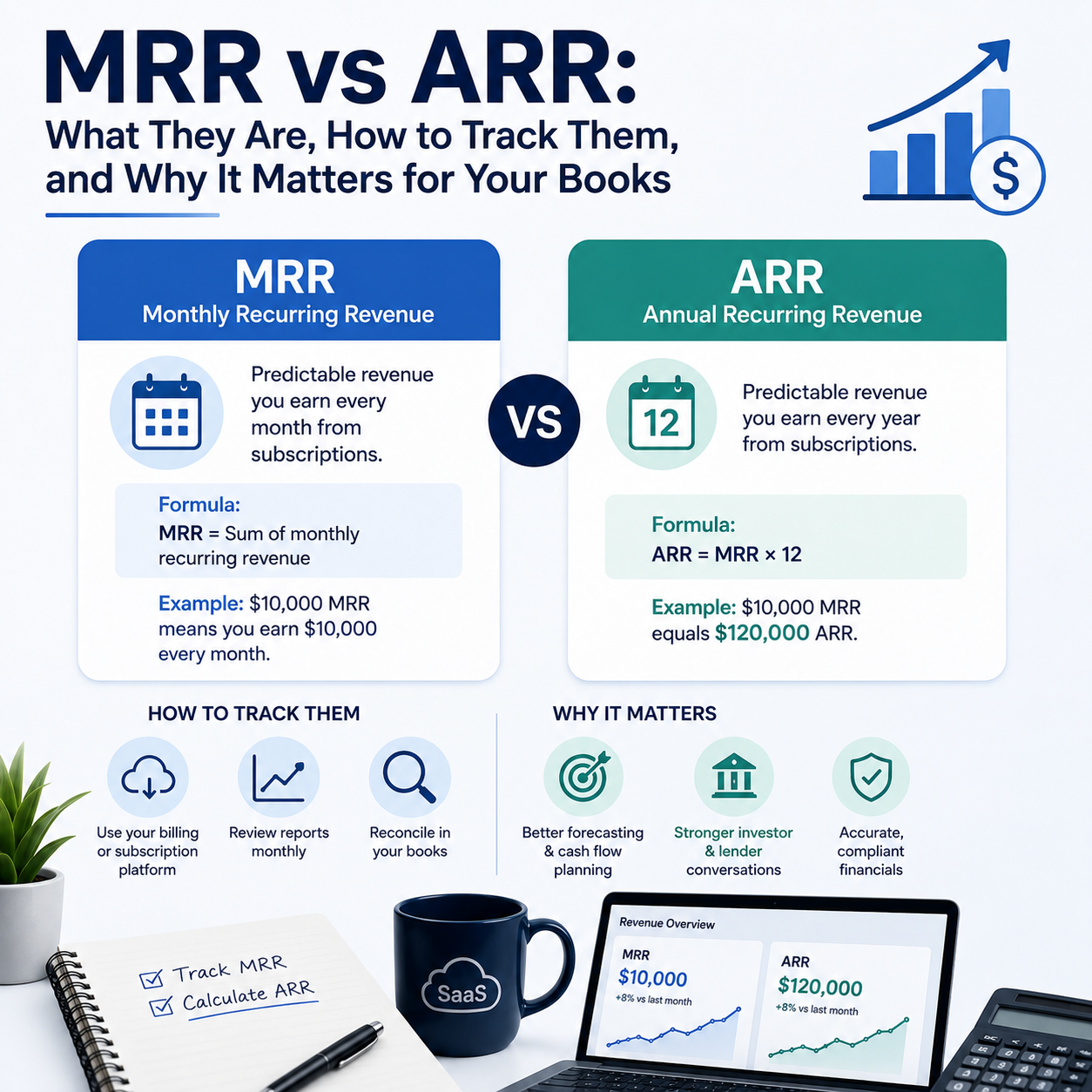

MRR vs ARR: What They Are, How to Track Them, and Why It Matters for Your Books
MRR and ARR get thrown around constantly in SaaS — on pitch decks, investor updates, and growth dashboards.
But most founders treat them as marketing metrics rather than financial ones. That's a mistake.
Monthly Recurring Revenue (MRR) and Annual Recurring Revenue (ARR) directly influence how you recognize revenue under GAAP, how investors assess your growth trajectory, and how your bookkeeper should be recording subscription income. Get them wrong and your books — and your story to investors — fall apart.
What Is MRR?MRR is the normalized monthly revenue generated from all active subscriptions.
The key word is normalized — it's not the cash you collected this month. It's the recurring portion of revenue, stripped of one-time fees, smoothed across billing cycles.Formula: MRR = (Number of paying customers) x (Average monthly subscription value)If a customer pays $600 for a six-month plan, their contribution to MRR is $100/month — not $600 in month one.
This normalization is what makes MRR useful for trend analysis and revenue recognition.What Is ARR?ARR is simply MRR multiplied by 12.
It represents the annualized run rate of your recurring subscription revenue — assuming no growth or churn.Formula: ARR = MRR x 12ARR is the number investors typically use to value SaaS businesses (ARR multiples are the basis for most SaaS valuations). It's also how you benchmark against industry growth rates and compare to competitors.
MRR Components Every Founder Should TrackNew MRR: Revenue from new customers acquired this month.Expansion MRR: Additional revenue from existing customers (upgrades, add-ons, seat additions).
Churned MRR: Revenue lost from customers who cancelled or downgraded.Net New MRR: New MRR + Expansion MRR — Churned MRR. This is your true growth signal.Tracking these components separately gives you — and your investors — a clear picture of whether growth is coming from acquisition, retention, or both.
Why MRR and ARR Matter for Your BooksMRR isn't just a metric — it drives your revenue recognition schedule. Under ASC 606, annual prepayments are recognized monthly (i.e., as MRR) not upfront.
So your bookkeeper should be reconciling your billing platform's MRR figure to your recognized revenue in QuickBooks or Xero every single month.Discrepancies between your MRR dashboard and your revenue recognition schedule are a red flag in due diligence. Clean
MRR tracking = clean books = faster funding.How to Track MRR CorrectlyUse a billing platform (Stripe, Chargebee, Maxio, or Recurly) that calculates MRR automatically and handles plan changes, proration, and cancellations.Reconcile billing platform MRR to your accounting software monthly — any difference signals a deferred revenue or recognition error.
Maintain a separate MRR waterfall table in your financial model showing New, Expansion, Contraction, and Churned MRR each month.Never mix one-time revenue (setup fees, professional services) into your MRR figure — it distorts growth metrics and misleads investors.