
You've had great investor conversations. The term sheet looks close. Then their team asks for your financial package — and things go quiet.
Financial due diligence is where many promising SaaS deals die. Not because the business isn't good, but because the books tell a different story than the pitch deck.
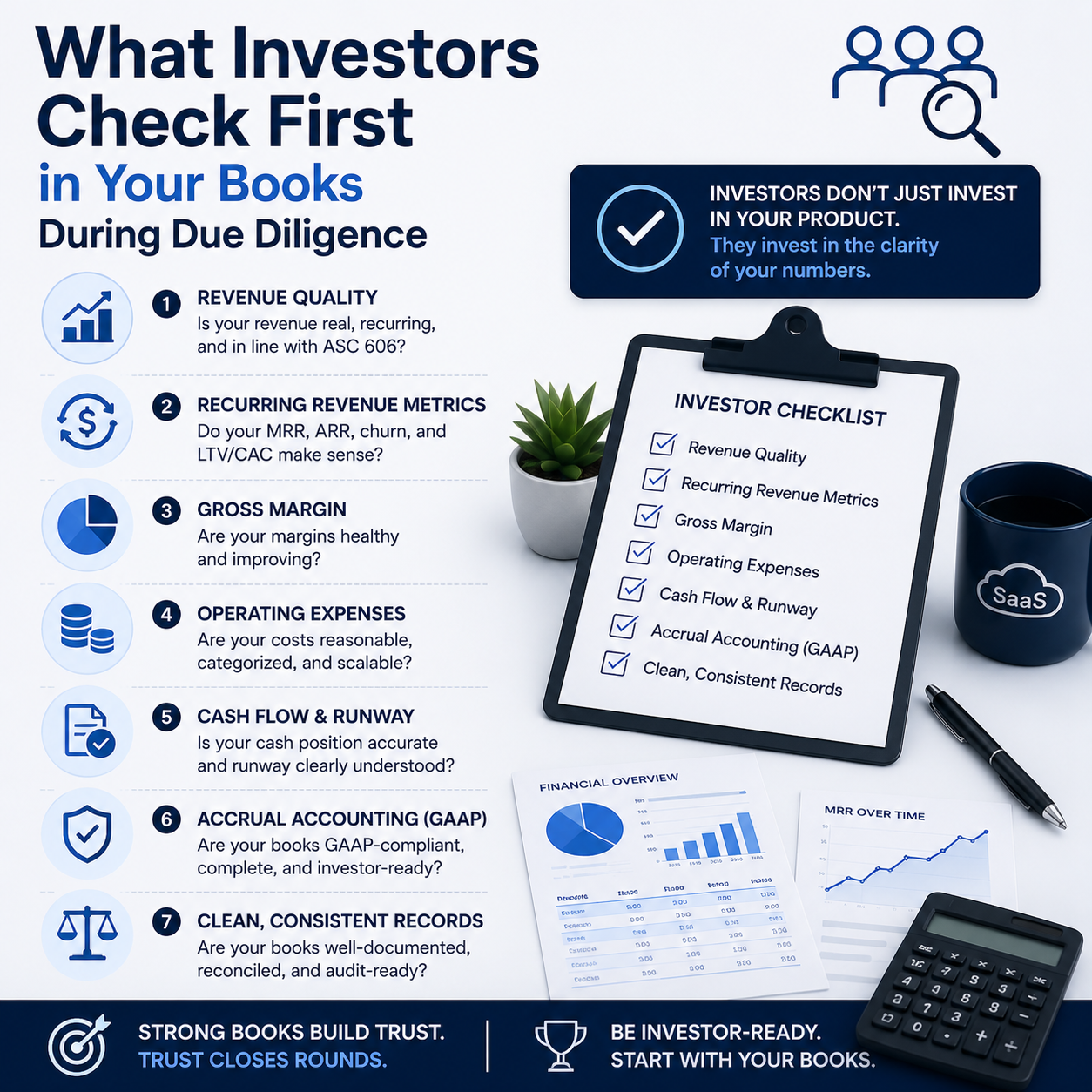
Here are the seven things investors check first — and what your books need to show.
1. Accounting Method:
The very first check: are you on accrual or cash basis? If your financials show cash-basis accounting, the investor's team will flag it immediately. Accrual-basis GAAP financials are the baseline requirement for any credible SaaS fundraise.
2. Revenue Recognition Schedule:
Investors want to see how you're recognizing revenue — and that it matches your billing system. They'll ask for a deferred revenue waterfall, a revenue reconciliation to your billing platform, and confirmation that ASC 606 is being applied correctly.A mismatch between your stated MRR and your recognized revenue is an immediate red flag that requires explanation.
3. Deferred Revenue Balance:
Your deferred revenue balance is proof of committed future revenue. Investors love it — it means customers have paid for services you haven't yet delivered, and that revenue is locked in.A missing or incorrect deferred revenue balance suggests your books aren't accrual-based or your billing reconciliation is broken.
4. Gross Margin and COGS:
SaaS gross margins should typically be 70–85%+ at scale. Investors will scrutinise your Cost of Goods Sold (COGS) to ensure it includes the right items: hosting/infrastructure, customer success, payment processing — not general operating expenses misclassified into COGS.Misclassified COGS artificially inflates your gross margin and will be caught.
5. Cash Flow Statement:
The cash flow statement tells the real story of your business liquidity. Investors specifically look at: operating cash flow vs net income (a big gap is a warning sign), changes in deferred revenue, and burn rate consistency.
6. Customer-Level Revenue Concentration
Does one customer represent 30%+ of your ARR? That's a concentration risk that investors will price into their valuation or use as a condition of funding. Your books should allow easy extraction of revenue by customer or contract.
7. Clean Expense Categorisation:
Investors look for proper separation of COGS, Sales & Marketing, R&D, and G&A. They'll benchmark your expense ratios against SaaS industry norms. Messy or inconsistent expense categorization signals weak financial controls and slows down diligence significantly