
🔍 Primary Keyword: ASC 606 revenue recognition SaaS
📌 Secondary Keywords: ASC 606 SaaS explained | revenue recognition SaaS startup | deferred revenue GAAP SaaS | subscription revenue recognition
📝 Meta Description: Everything SaaS founders need to know about ASC 606 revenue recognition — GAAP-compliant, investor-ready, and explained in plain English with real examples.
If you’re running a SaaS company, you’ve probably heard the term ASC 606 thrown around by your accountant, investors, or legal team. But what does it actually mean for how you recognize revenue — and why does it matter so much?
ASC 606 is the US GAAP standard that governs when and how companies recognize revenue from contracts with customers. For SaaS businesses, it’s not optional — it’s the difference between financials that pass investor scrutiny and books that quietly kill your fundraising round.
This guide breaks it all down: the five-step model, how subscription revenue gets treated, common mistakes founders make, and exactly what your bookkeeper should be doing to keep you compliant.
What Is ASC 606 and Why Does It Exist?
ASC 606 (Accounting Standards Codification Topic 606) is the revenue recognition standard issued jointly by the FASB and IASB, replacing a fragmented set of industry-specific rules with a single, principles-based framework. It went into effect for public companies in 2018 and for private companies in 2019.
The core idea is straightforward: revenue should be recognized when (and in the amount that) a company transfers control of a promised good or service to a customer. For SaaS, where you’re selling subscriptions delivered over time, this distinction is critical — cash collected upfront is not the same as revenue earned.
The Five-Step Revenue Recognition Model
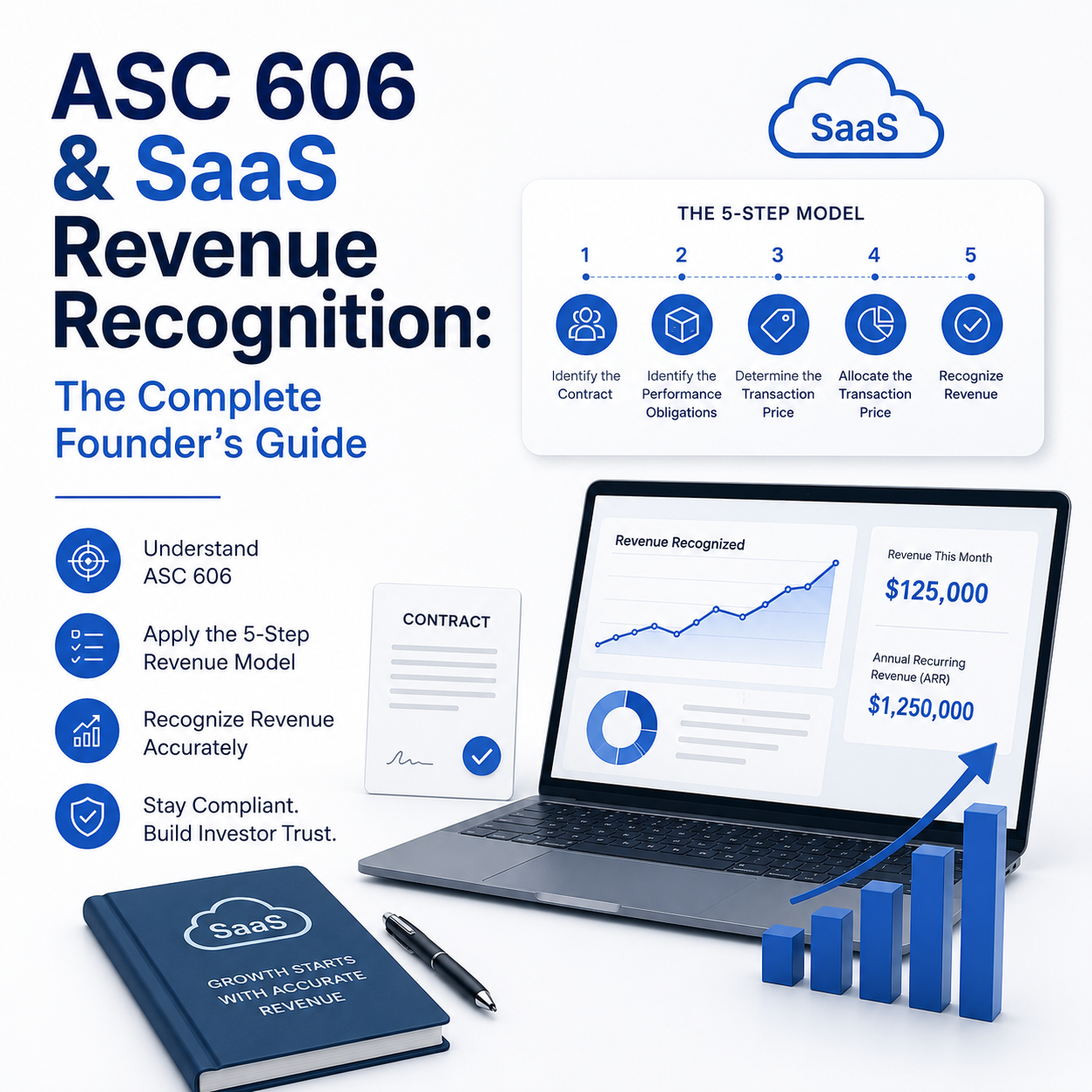
ASC 606 requires every revenue transaction to go through a five-step process:
Step 1 — Identify the contract: A contract exists when both parties have approved it, rights and payment terms are identifiable, and it has commercial substance.
Step 2 — Identify performance obligations: What have you promised the customer? For SaaS, this typically means access to software over a subscription period, but may also include onboarding, implementation, or support.
Step 3 — Determine the transaction price: This is the amount you expect to be entitled to receive — but it gets complicated with discounts, refunds, variable consideration, and multi-year deals.
Step 4 — Allocate the price to performance obligations: If a contract includes multiple deliverables (e.g., software + onboarding), the price must be allocated to each based on standalone selling prices.
Step 5 — Recognize revenue as obligations are satisfied: For SaaS subscriptions, revenue is typically recognized ratably (evenly) over the subscription period, not all at once when payment is received.
Deferred Revenue: What It Is and How It Works in SaaS
Here’s the core concept that trips up most founders: when a customer pays you $12,000 for an annual subscription upfront, you haven’t earned $12,000 yet. You’ve earned the right to $1,000 per month — as you deliver the service.
The remaining $11,000 sits on your balance sheet as deferred revenue (a liability) until it’s earned. Each month, $1,000 moves from deferred revenue to recognized revenue on your income statement.
Why does this matter? Because investors, auditors, and acquirers look directly at your deferred revenue balance. A well-managed deferred revenue schedule shows predictable, committed future revenue — a key SaaS health indicator.
Common ASC 606 Mistakes SaaS Founders Make
Recognizing all upfront payments as immediate revenue (cash-basis mistake).
Not identifying separate performance obligations when contracts include implementation or professional services — this leads to premature revenue recognition.
Failing to account for contract modifications when customers upgrade, downgrade, or extend mid-period.
Ignoring variable consideration such as usage-based fees, refund provisions, or performance bonuses — these require estimation under ASC 606.
Using the wrong standalone selling price to allocate consideration across bundled services, which distorts both revenue and deferred revenue balances.
How a SaaS Bookkeeper Handles ASC 606 for You
A bookkeeper who understands SaaS will build a monthly revenue recognition schedule that automatically defers and recognizes subscription revenue across the correct periods. They’ll reconcile your billing system (Stripe, Chargebee, Maxio) to your accounting software (QuickBooks, Xero) and ensure deferred revenue balances tie out to actual contracts.
The result: investor-ready financials that reflect the true economic health of your business — not just what hit your bank account.